
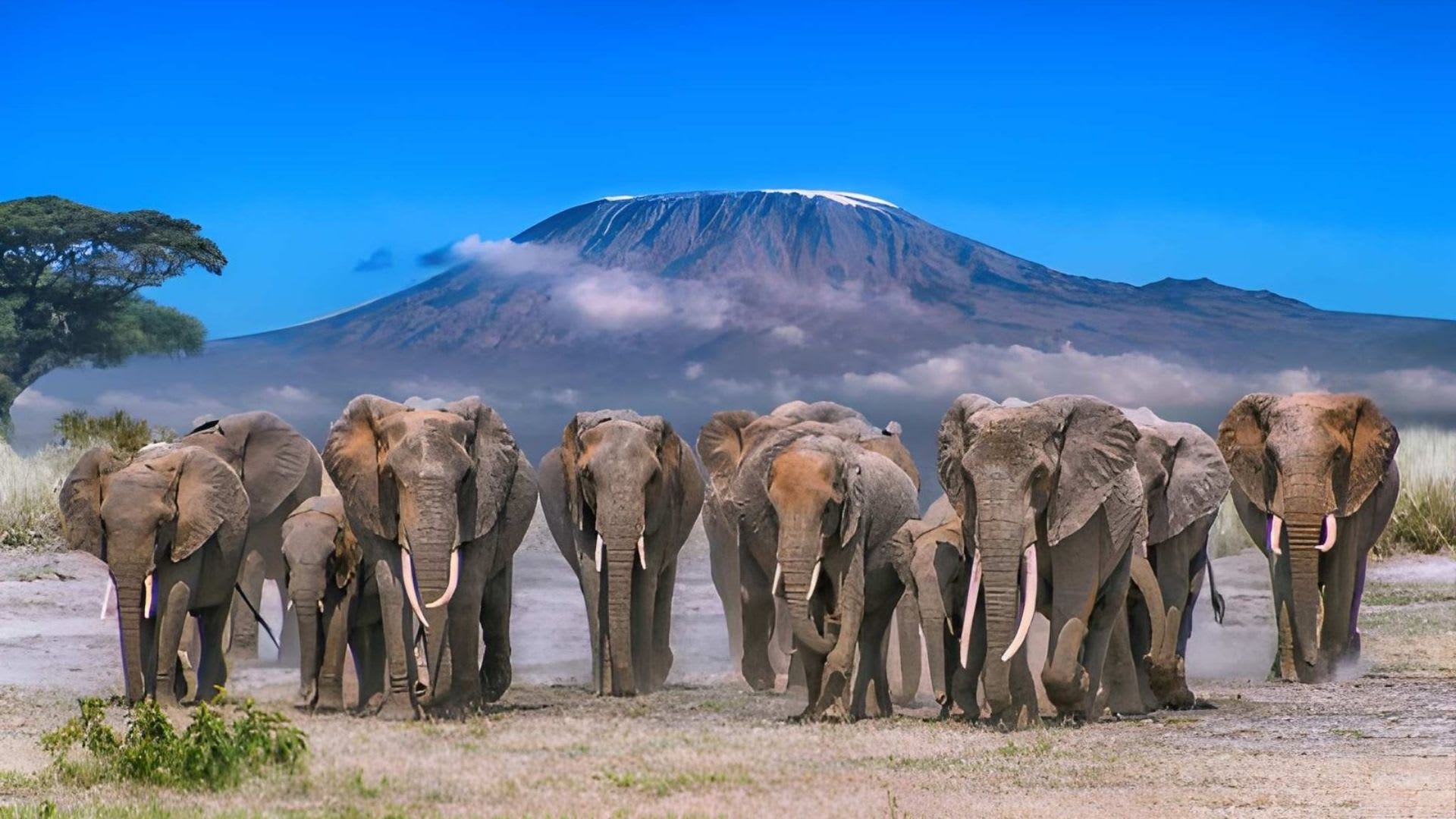
Elephants against snow-capped Kilimanjaro is one of Africa's most famous photos. Here's when the mountain shows itself, where to find the herds and which camera settings work.
A herd of elephants walks across open plains, dust glowing in the early light, while the snow-capped summit of Kilimanjaro rises behind them. It's one of the most famous images in African photography, and it's completely real. You can take it yourself in Amboseli National Park, a few hours' drive from Nairobi.
The catch is that Kilimanjaro is shy. This guide explains when the mountain shows itself, where to find the elephants, and how to set up your camera so the shot you bring home matches the one in your head.
Why Amboseli?
Amboseli is a relatively small park of about 392 km² at the foot of Kilimanjaro, Africa's highest mountain at 5,895 m. The mountain itself is in Tanzania, but the best views of it are from the Kenyan side.
Amboseli is also one of the best places in Africa to see elephants up close. The park's elephants have been studied continuously since 1972 by the Amboseli Trust for Elephants, one of the longest-running wildlife studies in the world. Because they're used to vehicles, they are often calm and relaxed, and big family herds and large-tusked bulls are regularly seen.
Swamps fed by underground water from Kilimanjaro's melted snow keep Amboseli green even in the dry season, and that's why the elephants stay.
The golden rule: go early
Kilimanjaro creates its own weather. As the day warms up, cloud builds around the summit and by mid-morning the mountain often disappears completely. Overnight the air cools and the cloud usually clears.
That means your best window is from sunrise to about 9 or 10 in the morning. Aim to leave camp at first light, around 6:00 AM. There's often a second, shorter window in the late afternoon as the cloud lifts again before sunset.
Plan your day around this: an early game drive for mountain shots, a rest in the heat of the day, and a late-afternoon drive for golden light.
Where to position yourself
- The open plains in the centre and north of the park give you the classic composition: elephants in the foreground with Kilimanjaro rising behind. Face south towards the mountain.
- The swamps, such as Enkongo Narok and Longinye, are where elephants gather to drink, bathe and feed during the day. Great for close-up action, with hippos, buffalo and water birds too.
- Observation Hill is one of the few places where you're allowed out of the vehicle. From the top you get a panoramic view over the swamps and plains, and it's a good way to spot where the herds are heading.
Your guide will know where the herds have been moving. Tell them early that you're after the Kilimanjaro shot so they can plan the morning route around it.
Best months to visit
| Months | Conditions | Kilimanjaro visibility |
|---|---|---|
| Jan to Feb | Hot and dry, clear skies | Excellent |
| Mar to May | Long rains, green landscapes | Often hidden by cloud |
| Jun to Oct | Cool and dry, dusty plains | Very good in the mornings |
| Nov to Dec | Short rains, lush and green | Variable |
January and February usually give the clearest views of the mountain. June to October is also excellent, with animals gathering around the swamps as the plains dry out, and dramatic dust in the morning light.
Camera settings that work
You don't need expensive equipment, but a few choices make a big difference.
Lenses
- 24 to 70 mm (or your phone's main camera) for wide "environmental" shots that show the whole scene: elephants, plains and mountain.
- 100 to 400 mm telephoto to fill the frame with elephants while keeping Kilimanjaro in the background. A longer lens also "compresses" the scene, making the mountain look larger behind the herd.
Settings
- Shoot in RAW if your camera allows it. It gives you much more room to recover detail in the bright sky and dark shadows.
- Expose for the sky. The snow on Kilimanjaro is the brightest part of the frame. If it turns pure white, the detail is lost. Use exposure compensation of −0.3 to −1 if needed.
- Use a fast shutter speed, 1/500 s or faster, for moving elephants, especially from a vehicle.
- Aperture f/8 to f/11 keeps both the elephants and the mountain reasonably sharp.
- Keep ISO as low as the light allows, raising it at dawn when light is limited.
Practical tips
- Bring a beanbag or rolled-up jacket to rest your lens on the vehicle window or roof. It's steadier than holding it.
- Ask the driver to switch off the engine before you shoot. Vibration softens photos.
- Protect your gear from dust with a cloth or bag, and change lenses inside the vehicle.
- Charge batteries and clear memory cards every night. You'll take more photos than you expect.
- Put the camera down sometimes. Some moments are best enjoyed with your own eyes.
Getting there and park fees
Amboseli is roughly 4 to 5 hours from Nairobi by road, via Emali or via Namanga. Flights from Wilson Airport take under an hour.
Amboseli is managed by KWS. Under the fees in force since October 2025, non-resident adults pay USD 90 per day and East African citizens KES 1,500. Fees are paid electronically, and they're included in Safarizuru safari packages.
Plan your Amboseli safari
Amboseli works well as a 2 or 3-night safari from Nairobi, and pairs nicely with Tsavo or the Maasai Mara on a longer trip. Tell us your dates and how many people are travelling, and we'll put together an Amboseli itinerary built around the best photography windows. Get a custom quote or browse all our safaris.
Frequently asked questions
Is Kilimanjaro visible every day in Amboseli?
No. The mountain is often covered by cloud, especially from late morning onwards and during the rainy seasons. Staying at least two nights gives you several early mornings, and therefore several chances of a clear view.
Can I take the Kilimanjaro photo with a phone?
Yes. Modern phones handle wide shots well. For close-up elephant shots with the mountain behind, a camera with a telephoto lens gives better results.
How close can you get to the elephants?
Very close, because Amboseli's elephants are used to vehicles. Your guide will keep a respectful distance and let the elephants come to you, which often leads to the best photos.
Ready to experience this yourself?
Browse our packages or get a custom quote.